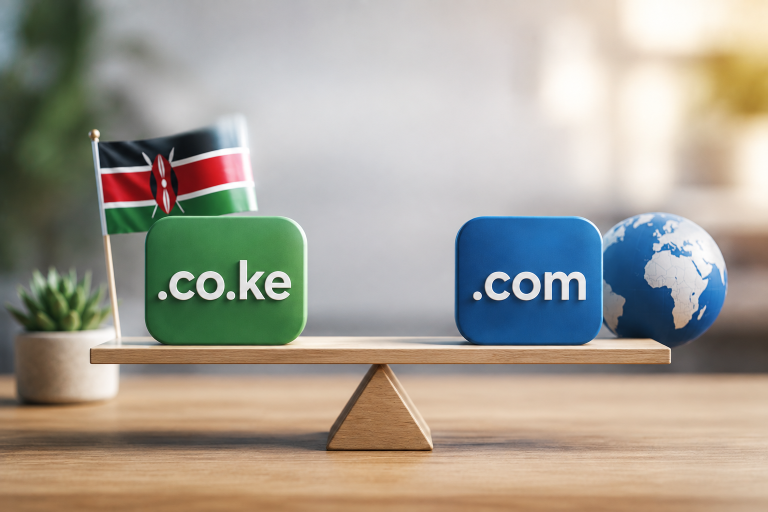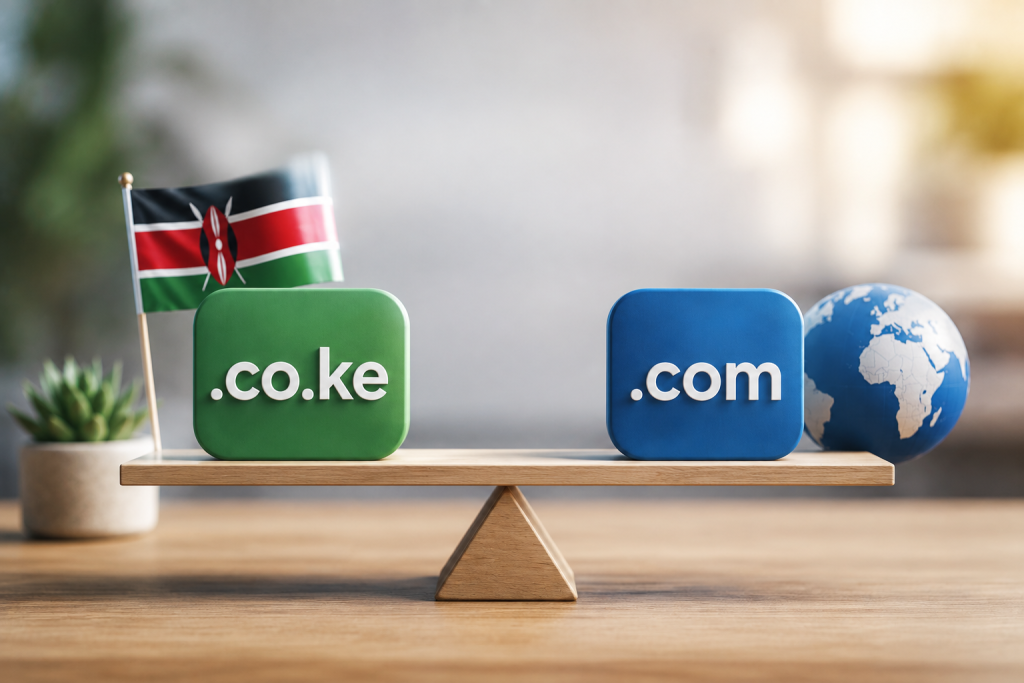
Choosing a domain name is one of those decisions that looks simple until you actually have to make it. You have settled on a business name, checked that the matching domain is available, and then you are faced with another question: should your Kenyan business use .co.ke or .com?
For many businesses in Kenya, both are perfectly viable options. A .co.ke domain immediately gives your website a Kenyan identity, while .com gives your brand a more geographically neutral, international presence. The better choice depends less on which extension is more popular and more on who your customers are, where you expect the business to grow, and how you want people to perceive your brand.
There is also no rule saying you have to choose only one. In many cases, registering both .co.ke and .com is the most sensible way to protect a growing brand.
In this guide, we will look at the practical differences between .co.ke and .com domains, how each can affect branding and SEO, what Kenyan businesses should consider before registering, and when it makes sense to secure both extensions.
What Is a .co.ke Domain?
A .co.ke domain is part of Kenya’s .ke country-code domain namespace. The .ke namespace is administered by the Kenya Network Information Centre (KeNIC), and .co.ke is the extension commonly associated with companies and commercial organisations.
A business called Karibu Furniture, for instance, could operate online as karibufurniture.co.ke. Even before somebody visits the website, the address gives them an immediate clue that the business has a connection to Kenya.
That local identity is one of the main reasons .co.ke remains attractive to Kenyan businesses. It works particularly well for companies whose customers are predominantly in Kenya, such as local retailers, professional services, schools, restaurants, construction companies, property businesses and e-commerce stores.
Kenya also has other extensions under the .ke namespace, including .ke, .or.ke and .ac.ke. They serve different purposes, so .co.ke should not simply be treated as another spelling of .ke. We will look at that distinction separately in our guide to .ke vs .co.ke.
If you have already decided that .co.ke is the right extension for your business, you can read our step-by-step guide to registering a .co.ke domain in Kenya or check availability directly through HostGuru Domain Registration.
What Is a .com Domain?
.com is a generic top-level domain and one of the most widely recognised domain extensions in the world. Unlike .co.ke, it is not tied to Kenya or any other individual country.
That makes .com particularly attractive to businesses that want a geographically neutral identity. A software company founded in Nairobi, for example, might have customers in Kenya today but intend to sell across Africa, Europe and North America. In that situation, a .com domain can comfortably follow the business into each new market without making one country the centre of its online identity.
This does not mean .com is somehow more professional than .co.ke. Both can support serious businesses, online stores and corporate websites. The difference is primarily the message each extension sends about the market the business serves.
.co.ke vs .com: The Main Differences
From a technical point of view, there is very little you can do with a .com domain that you cannot also do with a .co.ke domain. Both can host WordPress websites, WooCommerce stores, Laravel applications, business email and practically any other conventional web application.
The meaningful differences are in geographic identity, branding, domain availability and the audience you want to reach.
| Factor | .co.ke | .com |
|---|---|---|
| Geographic identity | Strongly associated with Kenya | Global and geographically neutral |
| Best suited to | Kenyan and locally focused businesses | International and multi-country brands |
| Local branding | Excellent | Neutral |
| International recognition | Good | Excellent |
| Availability of Kenyan business names | Often better | Popular names are frequently taken |
| Professional email | Yes | Yes |
| WordPress & WooCommerce | Yes | Yes |
For most businesses, therefore, the decision is not about functionality. It is about positioning.
Is .co.ke Better Than .com for SEO in Kenya?
This is probably the biggest source of confusion in the .co.ke versus .com debate.
A .co.ke domain gives search engines a clear geographic signal that the website is associated with Kenya. Google explains in its documentation on managing international and multi-regional websites that country-code domains provide a strong geographic signal.
That makes .co.ke particularly relevant when Kenya is genuinely the market you want to serve. However, it does not mean that simply registering a .co.ke domain will make your website rank above .com websites in Kenyan Google results.
A poorly built .co.ke website with weak content, few useful backlinks and slow pages will not automatically outrank a well-established .com competitor simply because its domain ends in .co.ke.
Google still has to determine whether the page actually deserves to rank.
Good SEO depends on much more: useful content, search intent, website structure, backlinks, technical performance, mobile usability, internal linking and the overall authority of the website all play a role.
It is therefore more accurate to think of .co.ke as providing a local relevance signal rather than an automatic SEO advantage.
Does a .co.ke Domain Build More Trust in Kenya?
For some businesses, this is where .co.ke has its biggest advantage.
Imagine that you are searching online for an electrician, accountant or cleaning company in Nairobi. You come across two unfamiliar businesses:
examplebusiness.co.ke
examplebusiness.com
Without knowing anything else about either company, the first domain immediately communicates a connection to Kenya. That can be reassuring when the service itself depends on location.
A Kenyan customer looking for someone to install CCTV cameras in Kiambu does not particularly care whether that company has an international-looking domain. They care whether the company is actually available in Kiambu.
The same applies to businesses such as law firms, restaurants, schools, clinics, real-estate agencies, local retailers, construction companies and many professional services. In these cases, being recognisably Kenyan can strengthen the brand rather than limit it.
However, the situation changes when location is less important to the product. A software company can be headquartered in Nairobi while serving customers anywhere in the world. For that company, a geographically neutral .com may fit the brand better.
When Should a Kenyan Business Choose .co.ke?
A .co.ke domain makes the most sense when Kenya is central to the business rather than simply being where the founders happen to live.
Consider .co.ke if most of your customers are Kenyan, your products or services are primarily available within Kenya, or a Kenyan identity is an important part of how you want the business to be perceived.
A local furniture store serving Nairobi and its surrounding counties is a good example. If virtually all of its customers are in Kenya, there is little commercial benefit in trying to make the website appear geographically neutral. A clean .co.ke domain tells customers exactly where the business belongs.
The same is often true for Kenyan:
- Professional service firms
- Retail businesses
- Schools and training businesses
- Restaurants and hospitality businesses
- Property and construction companies
- Clinics and healthcare businesses
- Local e-commerce stores
- Consultants and agencies serving Kenyan companies
Another practical advantage is availability. Because .com has been used globally for decades, many desirable names have already been registered. Your exact company name may therefore be unavailable as a .com but still available as a clean .co.ke.
When Does .com Make More Sense?
The case for .com becomes stronger when the business is designed to operate beyond one country.
Suppose you are launching a SaaS company in Nairobi. Your first customers may be Kenyan, but the software itself can be used by businesses in Uganda, Rwanda, Nigeria, South Africa, the UK or the United States.
In that situation, a .com domain gives the company room to grow without tying the entire brand to one geographic market.
The same may apply to international consulting firms, technology companies, global e-commerce brands, exporters and digital businesses whose customers can come from practically anywhere.
Notice that this is about the customer base, not simply the physical location of the company. A Kenyan company can be global, just as an international company can have a website specifically dedicated to Kenyan customers.
What If Your Business Plans to Expand Outside Kenya?
This is worth thinking about before you register anything.
A business may be entirely Kenyan today but have realistic plans to enter Uganda, Tanzania, Rwanda or markets further abroad. If international expansion is central to the business model, securing the .com early can prevent complications later.
That does not necessarily mean you should abandon .co.ke.
You could use yourbrand.com as the main international website while retaining yourbrand.co.ke for Kenyan customers. Larger businesses sometimes use country-specific domains, subdomains or country folders to organise content for different markets.
Google supports several approaches to multi-regional websites, so there is no requirement that every expanding company follow exactly the same structure. What matters is that the architecture is deliberate rather than something you have to improvise after the business has already accumulated years of traffic and backlinks.
What If Your .com Domain Is Already Taken?
This is where many businesses make a poor decision.
Imagine your company is called Karibu Interiors. You search for:
karibuinteriors.com
and discover that somebody already owns it.
You then notice:
karibuinteriors.co.ke
is available.
In this situation, the clean .co.ke domain may be much better than turning the .com into something awkward such as:
karibu-interiors-kenya-online-ltd.com
A good domain should be easy to remember, easy to type and easy to say aloud. Adding unnecessary words, numbers or hyphens just to secure a .com can weaken your brand more than choosing a different extension.
This is particularly relevant for Kenyan SMEs because .co.ke can give businesses access to strong, brandable names that disappeared from the .com namespace years ago.
Should You Put SEO Keywords in Your Domain Name?
There was a time when businesses routinely registered domains stuffed with keywords because they expected the domain itself to push them to the top of Google.
That is not a sensible modern SEO strategy.
A domain such as:
best-cheap-plumbers-nairobi-kenya.co.ke
may contain several search terms, but it is hardly an attractive brand.
If your plumbing company is called MajiFix, then:
majifix.co.ke
is shorter, cleaner and easier for a customer to remember.
Your service pages can target searches such as “emergency plumber Nairobi” or “water tank installation Kenya.” The domain does not need to contain every keyword the business hopes to rank for.
Google itself notes in its SEO Starter Guide that keywords in a domain name have relatively little ranking effect compared with what some website owners assume.
Build a domain for the brand you want people to remember. Build your SEO through the website that lives on it.
Can You Use Professional Email With .co.ke and .com?
Yes. Both extensions work perfectly well with professional business email.
A company using .co.ke might have:
[email protected]
[email protected]
[email protected]
A company using .com can create the same addresses using its .com domain.
The extension does not determine the quality or functionality of your email service. Your email provider and DNS configuration handle that.
If you are setting up email for a company, our Professional Business Email in Kenya guide explains why using your own domain is generally preferable to conducting company communication entirely through a personal Gmail or Yahoo address.
Can a .com Website Still Accept M-Pesa?
Absolutely.
Your domain extension has nothing to do with whether your website can accept M-Pesa, cards, bank payments or another payment method.
A WooCommerce store at shop.co.ke can accept M-Pesa, and so can one at shop.com. Payment functionality is determined by your website platform and payment integration, not the final letters in your domain name.
The same principle applies to WordPress, WooCommerce, Laravel and other web applications.
Do .co.ke and .com Need Different Web Hosting?
No. A domain and a hosting account are separate components of your website.
The domain is the address people type into their browser. Web hosting is the infrastructure that stores and runs the website behind that address.
You can therefore host a .co.ke and a .com domain on exactly the same hosting platform. You can even point both domains to the same website if that is how you choose to structure the brand.
If you are still working out the total cost of putting your business online, read our complete guide to web hosting costs in Kenya. It explains how domains, hosting, SSL, email and other website costs fit together.
Should You Register Both .co.ke and .com?
If your business name is important to you and both domains are available, registering both is often worth considering.
Suppose you are launching a company called Savanna Foods and both of these are available:
savannafoods.co.ke
savannafoods.com
If Kenya is your main market, you could make savannafoods.co.ke your primary website and redirect savannafoods.com to it.
If you are building Savanna Foods as an international brand, you might do the opposite: use the .com as the primary website while retaining the .co.ke domain for brand protection or future Kenyan-specific use.
Registering both helps prevent another party from easily acquiring the alternative version of your brand. It also catches customers who remember your company name correctly but type the wrong extension.
This becomes increasingly valuable as a business grows. Registering an available domain today is considerably easier than trying to buy it from somebody else after your brand has become successful.
Should You Put the Same Website on Both Domains?
Usually, no.
Owning both domains does not mean you should maintain two identical websites that compete with each other.
If the domains serve the same customers and contain the same website, choose one as your primary domain and redirect the other to it. That gives customers and search engines one clear version of the website.
There are legitimate reasons to operate different regional versions of a website, but that requires a proper international SEO structure rather than simply cloning the same pages across several domains.
What About .ke Instead of .co.ke?
Kenyan businesses are no longer limited to choosing between .co.ke and an international extension such as .com. The shorter direct .ke domain is another option.
For example:
yourbrand.ke
is shorter than:
yourbrand.co.ke
Both are part of Kenya’s domain namespace, but they are different extensions and can have different branding considerations.
If you already know you want a Kenyan domain but are unsure which of these two to use, our upcoming .ke vs .co.ke guide will look specifically at that decision.
How Much Do .co.ke and .com Domains Cost in Kenya?
Price matters, but it should not be the only factor used to choose a domain you may keep for the next ten or twenty years.
Domain registration and renewal prices vary by extension and can change over time. Promotional first-year prices can also differ from the normal renewal price.
When comparing domain prices, look at the complete cost of ownership rather than only the headline registration offer. Check the initial registration fee, annual renewal price, transfer cost, DNS management and any other services included by the registrar.
You can view the latest prices for .co.ke, .com, .ke and other extensions on the HostGuru domain pricing page.
We will also cover this subject in more detail in our guide to domain prices in Kenya, including the difference between registration, renewal and transfer fees.
.co.ke or .com for an Online Store in Kenya?
If your online store mainly sells to Kenyan customers, .co.ke is a strong fit. It reinforces the local identity of the store and can sit naturally alongside prices in Kenyan shillings, local delivery information and M-Pesa payment options.
If you expect to sell internationally, .com may offer a more flexible identity.
Consider where you expect most of your revenue to come from rather than simply choosing the extension used by the biggest international brands.
A Kenyan online store does not become more credible simply by changing .co.ke to .com. Customer trust will also depend on product quality, website security, transparent delivery information, payment options, customer service and the overall shopping experience.
.co.ke or .com for a Kenyan Startup?
Startups should think particularly carefully about where the business could be in several years.
If you are developing a service specifically for Kenyan schools, farmers, landlords or SMEs, .co.ke can fit the product extremely well.
If you are building technology that could serve customers anywhere in the world, securing the .com early may give you more flexibility as the company expands.
If you genuinely do not know which direction the business will take and both domains are available, securing both is often the easiest way to keep your options open.
.co.ke or .com for a Local Service Business?
For businesses whose customers are overwhelmingly local, the case for .co.ke becomes particularly strong.
A Nairobi electrician, Mombasa restaurant, Nakuru accountant or Kiambu construction company does not need to disguise its location. Local relevance is part of what the customer is looking for.
In those situations, a Kenyan domain can complement the rest of the business’s local presence rather than restrict it.
.co.ke or .com for a Tourism Business?
Tourism is an interesting exception because a company can be entirely Kenyan while most of its customers live overseas.
A safari operator may work exclusively in Kenya but market heavily to travellers in the United States, UK and Europe. A .com can therefore make sense because the customer base is international.
On the other hand, a .co.ke address can reinforce the fact that the operator is actually based in Kenya, which may itself be valuable to the brand.
There is no universal answer here. The better choice depends on how the company wants to position itself and how customers normally discover it.
So, Which Is Better: .co.ke or .com?
If your business primarily serves customers in Kenya, .co.ke is usually an excellent choice. It gives your website a clear Kenyan identity, suits locally focused branding and may give you access to a cleaner version of your business name when the equivalent .com has already been registered.
If you are building a company for an international audience, .com may be the better long-term choice. Its geographic neutrality makes it particularly suitable for global technology companies, international e-commerce brands and businesses that expect to operate across several countries.
For many serious businesses, however, the best answer is not necessarily one or the other.
Register both if you can.
Choose the extension that best represents your primary market, use it as the main website, and redirect the second domain appropriately. That gives you greater control over your brand while leaving room for the business to grow.
| Your Business | Recommended Approach |
|---|---|
| Primarily serves Kenyan customers | .co.ke |
| Local Kenyan SME | .co.ke |
| Local professional or service business | .co.ke |
| Global SaaS or technology company | .com |
| International e-commerce brand | .com |
| Kenyan tourism company serving overseas customers | Either, depending on brand positioning |
| Growing brand and both domains are available | Register both |
Most importantly, do not choose .co.ke because somebody told you it guarantees higher Google rankings, and do not choose .com because you think a Kenyan domain somehow looks less professional.
Your domain should make sense for your customers, your brand and where you want the business to go.
Frequently Asked Questions
Is .co.ke better than .com in Kenya?
For a business primarily serving Kenyan customers, .co.ke can be the better choice because it clearly communicates a connection to Kenya. For a business targeting customers internationally, .com may provide a more geographically neutral identity. Neither extension is automatically better for every business.
Does .co.ke rank better than .com on Google Kenya?
Not automatically. A .co.ke domain provides a geographic signal associated with Kenya, but Google considers many other factors when ranking websites. Content quality, relevance, backlinks, technical SEO and overall site quality remain important regardless of the domain extension.
Can I register both .co.ke and .com?
Yes. If both versions of your business name are available, registering both can be a useful brand-protection strategy. You can choose one as your primary website and redirect the other domain to it.
Can I use .co.ke for an international business?
Yes, but consider how strongly you want the brand associated with Kenya. If the majority of your customers will eventually be outside Kenya, a geographically neutral .com may provide more flexibility.
Can I use M-Pesa with a .com website?
Yes. Your domain extension does not determine which payment methods your website can use. A .com or .co.ke website can integrate M-Pesa if the website platform and payment gateway support it.
Can I have business email with a .co.ke domain?
Yes. You can create professional addresses such as [email protected], [email protected] and [email protected] just as you would with a .com domain.
What should I do if my .com is taken but .co.ke is available?
If Kenya is an important market for your business, the clean .co.ke version of your brand can be a much better choice than adding unnecessary words, numbers or hyphens simply to obtain an available .com.
Should a Kenyan business register both .co.ke and .com?
If the budget allows and both domains are available, it is worth considering. Owning both gives you greater control over your brand and prevents another party from easily registering the alternative extension. You should still choose one primary domain for the website.
Find Your Domain With HostGuru
Your domain is more than an address. It becomes part of how customers remember your business, find you online and communicate with you.
HostGuru offers .co.ke, .ke, .com and hundreds of other domain extensions, making it easy to compare your options before deciding which name should represent your business.
Search for your domain name with HostGuru →
Already decided on a Kenyan domain? Read our How to Register a .co.ke Domain in Kenya guide for the next steps.
Disclaimer: Domain availability, registration requirements and pricing can change. Always check the current registration and renewal terms for your chosen domain extension before purchasing.